


Hi, I’m Scott Paul, a licensed exterior restoration contractor with over 30 years of experience and 10,000+ deck restorations. My Rust-Oleum RockSolid review is based on my history as a wood restoration contractor and actual hands-on testing. See my full credentials and testing stats here.
Rust-Oleum RockSolid Deck Coating Review 2026
Here at DeckStainHelp.com, we have worked hard over the years to become a trusted reference for deck stain reviews and consumer feedback. Thank you for your continued support.
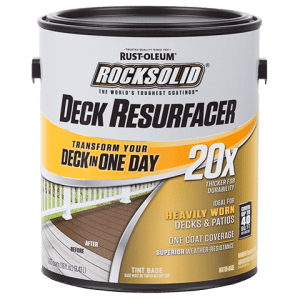
Rust-Oleum RockSolid is a high-build, water-based acrylic deck coating sold as a “deck resurfacer.” It is Rust-Oleum’s current product in the same category as its earlier Restore line (Deck Restore, Deck & Concrete Restore, and Restore 10X), which was the subject of a class action lawsuit over peeling and adhesion failures.
RockSolid is marketed with a primer and a “deck in one day” application process. Based on my own testing and the feedback we continue to receive from readers, RockSolid does not appear to perform meaningfully better than the earlier Restore products. Peeling and coating failure remain the most common complaints.
If you have used Rust-Oleum RockSolid, I would like to hear about your experience. Share your results and photos in the comments below.
- Rust-Oleum RockSolid scored only 4.25 out of 10 in testing, with peeling starting within the first year on a cold-weather deck.
- RockSolid follows the same film-forming approach as Restore, which led to a $9.3 million class action settlement over peeling and adhesion failures.
- Real-world coverage was roughly 20 sq. ft. per gallon, far below the claimed 80, pushing costs above $1.75 per square foot before primer.
- Thick coatings like RockSolid trap moisture under the film, causing bubbling, peeling, and rot, especially in cold climates with freeze-thaw cycles.
- Penetrating semi-transparent or semi-solid deck stains are a better long-term alternative, fading gradually instead of peeling and requiring only simple prep to recoat.
The Rust-Oleum Restore Class Action Lawsuit
Rust-Oleum’s earlier Restore deck and concrete resurfacing products were the subject of a consolidated class action lawsuit in federal court in Illinois. Homeowners alleged that the coating peeled and chipped soon after application, and in some cases forced them to replace their deck boards.
Rust-Oleum denied the claims but agreed to a $9.3 million settlement, which received final court approval in March 2017. Settlement checks were mailed in 2018. The settlement covered Deck & Concrete Restore, Deck Restore, Concrete Restore, and Restore 10X purchased between January 1, 2008 and October 20, 2016. The claim period is now closed.
RockSolid was not part of that settlement. For full background, see my article on the class action lawsuit against Rust-Oleum Deck Restore and this news coverage of the original complaint.
RockSolid Product Description
Rust-Oleum markets the RockSolid deck coatings as a way to “transform your deck in one day.” There are two main versions:
- RockSolid 6X Deck Coat: For moderately worn decks and patios. Marketed as 6X thicker than standard coatings, with one-coat coverage of up to 80 sq. ft. per gallon.
- RockSolid 20X Deck Coat: A thicker version for heavily worn decks, with lower coverage per gallon.
Manufacturer claims include:
- One-coat coverage
- Weather resistance and waterproofing protection
- Fills hairline cracks
- Available in 60+ tintable colors
- For use on wood decks and concrete patios
Rust-Oleum requires one coat of RockSolid Deck Start Wood Primer on wood before the deck coat, and recommends cleaning first with RockSolid Deck & Patio Cleaner.
How I Rated Rust-Oleum RockSolid
- Appearance After Application
- Preventing UV Graying
- Peeling or Wearing
- Cost Per Square Foot
- Preventing Mold and Mildew
- Ease of Application
- Color Shifting
- Ease of Reapplication
8-Step Review of Rust-Oleum RockSolid
1. Appearance After Initial Application: 3
The finished appearance was poor. The coating looked clumpy, and dirt stuck to the surface while it cured. The final color did not match the color chart.
2. Preventing UV Graying at the 1 Year Mark: 10
There was no graying in the areas where the coating had not peeled. As a thick solid coating, it fully blocks UV where it remains intact.
3. Wear/Tear and Peeling: 2
In my testing, RockSolid peeled the worst of all the deck resurfacer products I have tested. It started peeling within the first year on our cold-weather test deck.
4. Cost Per Square Foot: 1
Coverage was far below what we expected. We got closer to 20 sq. ft. per gallon rather than 30 sq. ft. per gallon. We spent over $350 on our 200 sq. ft. deck, or more than $1.75 per square foot, not counting the primer and cleaner.
5. Preventing Mold/Mildew/Algae: 6
About 40% of the deck surface showed mold growth by the end of the test period.
6. Ease of Application: 1
This product is difficult to apply. It splatters, and we had to constantly back-roll to get an even appearance. The roller cover that comes with the kit wore out quickly. It feels like applying a coat of tar mixed with sand.
7. Color Shifting (Darkening) After 1 Year: 10
The RockSolid coating did not darken in color.
8. Ease of Reapplication: 1
Be prepared to power sand this coating off if you switch to a different product. If moisture gets trapped under the coating and rot sets in, some deck boards may need to be replaced.
My Overall Score for Rust-Oleum RockSolid at 1 Year: 4.25
Based on my testing, the large number of negative consumer reviews online, and the history of the earlier Restore products, I cannot recommend Rust-Oleum RockSolid for wood decks.
Rust-Oleum RockSolid and Restore Customer Photo Issues
Why Deck Resurfacers Fail
Deck resurfacers like RockSolid are thick, film-forming coatings. They sit on top of the wood rather than soaking in. On a horizontal deck surface, that creates several problems:
- Wood moves; coatings do not. Deck boards swell and shrink with every change in moisture and temperature. A thick, rigid film cannot keep up, so it cracks and lets water in.
- Trapped moisture. Water enters through cracks, end grain, and the undersides of boards, then gets trapped under the coating. That leads to bubbling, peeling, and eventually rot.
- Freeze-thaw cycles. In cold climates, trapped water freezes and expands under the film, which accelerates peeling.
- Foot traffic. Stairs, doorways, and walkways wear through first, leaving a patchy look that cannot be spot-repaired cleanly.
- Prep sensitivity. Any dirt, mildew, old stain, or moisture in the wood at application time weakens adhesion.
These products can hide splinters and cracks for a season, but they do not fix worn wood. Badly damaged boards should be replaced rather than coated.
How to Remove RockSolid From a Deck
Removing a thick resurfacer is one of the hardest jobs in deck restoration. Here is the process I recommend:
- Scrape loose material with a stiff scraper to remove any peeling or flaking areas.
- Apply a heavy-duty stripper made for thick acrylic coatings. Expect multiple applications, and keep the stripper wet while it works.
- Pressure wash at the lowest pressure that removes the softened coating, keeping the tip 8 to 12 inches from the boards.
- Power sand any remaining coating with a floor sander or orbital sander, using 60 to 80 grit paper and no finer.
- Replace any rotted boards found under the coating.
- Brighten the wood with a wood brightener, let it dry, and apply a penetrating stain.
On large decks or decks with heavy buildup, replacing the deck boards can cost about the same as removal. Get a professional opinion before you start.
Better Alternatives to Deck Resurfacers
For most wood decks, a penetrating deck stain is a better long-term choice than a resurfacer. Penetrating stains soak into the wood, wear away gradually instead of peeling, and can be recoated after a simple cleaning and brightening.
- Semi-transparent stains show the wood grain and are the easiest to maintain.
- Semi-solid stains add more color and help hide imperfections on older, weathered wood, while still penetrating.
- Board replacement is the right fix when wood is rotted, deeply split, or badly splintered. No coating will fix structurally damaged boards.
Compare my top-rated products in my best deck stain reviews and ratings guide.
Looking for a Better Option?


Rust-Oleum RockSolid Product Information
- Manufacturer: Rust-Oleum
- Where to Buy: Home Depot, Lowe’s, Walmart, Amazon, and select retailers
- Cost: About $49 per gallon. Deck Start Wood Primer is required on wood and sold separately.
- Product Type: Water-based, high-build acrylic deck resurfacer (film-forming)
- Available Colors: 60+ tintable colors
- Application Temperature: 45 to 95 F
- Coats Required: 1 coat of primer plus 1 coat of deck coat
- Manufacturer Coverage Claim: Up to 80 sq. ft. per gallon (6X), less for 20X
- Our Real-World Coverage: About 20 sq. ft. per gallon
- Application Tools: Brush, RockSolid roller cover
- Dry Time: 8 to 24 hours
- Cleanup: Soap and water
Test Deck Stats
- Deck Wood Type: Pressure-treated pine
- Deck Square Footage: 200
- UV Exposure: Full sun
- Climate: Cold-weather state
- Years Tested: 1+
- Color Used: Cedar
Rust-Oleum RockSolid FAQs
Is Rust-Oleum RockSolid the same as Deck Restore?
RockSolid is Rust-Oleum’s current deck resurfacer line and uses the same basic approach as the earlier Restore products: a thick, film-forming acrylic coating applied over the wood. Rust-Oleum now pairs it with a required primer. In my testing, RockSolid peeled within the first year, similar to the problems reported with Restore.
Is there a class action lawsuit against Rust-Oleum RockSolid?
The class action settlement covered Rust-Oleum’s earlier Restore products, not RockSolid. Rust-Oleum denied the claims but agreed to a $9.3 million settlement covering Deck & Concrete Restore, Deck Restore, Concrete Restore, and Restore 10X purchased between 2008 and October 20, 2016. The settlement received final approval in 2017.
Can I still file a claim in the Rust-Oleum Restore settlement?
No. The claim period for the Rust-Oleum Restore settlement has closed, and settlement checks were mailed in 2018. If you have a problem with a Rust-Oleum product today, contact Rust-Oleum directly about its product warranty.
Does Rust-Oleum RockSolid peel?
In my testing, yes. RockSolid started peeling within the first year on our cold-weather test deck, and peeling is the most common complaint I hear from readers. As a thick film-forming coating, it cannot flex with the wood as boards swell and shrink, so it cracks, lets water in, and peels.
How long does Rust-Oleum RockSolid last?
On our test deck, RockSolid began peeling within the first year. Results vary with prep, climate, and sun exposure, but deck resurfacers generally fail fastest on horizontal surfaces in cold climates with freeze-thaw cycles.
How do you remove Rust-Oleum RockSolid from a deck?
Scrape off loose coating, apply a heavy-duty stripper made for thick acrylic coatings, pressure wash at low pressure, and power sand what remains with 60 to 80 grit paper. Expect multiple stripper applications. Replace any rotted boards, then brighten the wood before applying a penetrating stain.
How much does a gallon of RockSolid cover?
Rust-Oleum claims up to 80 square feet per gallon for the 6X Deck Coat with one coat. On our test deck, we got closer to 20 square feet per gallon, which made the cost far higher than expected.
Do you need a primer with RockSolid?
Yes. Rust-Oleum requires one coat of RockSolid Deck Start Wood Primer on wood decks before applying the deck coat. The primer is sold separately and adds to the total cost.
Can I apply RockSolid over an existing deck stain?
Rust-Oleum says the surface must be clean, dry, and free of any loose or unsound coatings before application. I do not recommend applying any thick resurfacer over existing stain, because adhesion problems are the main way these products fail.
Can I use RockSolid on a new pressure-treated deck?
I do not recommend it. New pressure-treated lumber needs months to dry, and a thick coating over wood that still holds moisture is likely to peel. A penetrating stain applied after the wood has dried is a much better choice for new decks.
Is RockSolid better on concrete patios than wood decks?
Concrete does not swell and shrink with moisture the way wood does, so film-forming coatings generally hold up better on concrete than on wood. Rust-Oleum does not recommend RockSolid for driveways, garages, or areas with vehicle traffic.
What should I use instead of a deck resurfacer?
For most wood decks, use a penetrating semi-transparent or semi-solid deck stain. Penetrating stains soak into the wood, fade gradually instead of peeling, and are easy to recoat. If boards are rotted or badly split, replace them rather than coating over them.
*All products tested and results are from our experience. We offer no guarantee of similar results. Results may differ due to wood type, UV exposure, climate, and natural weathering.
My Rust-Oleum RockSolid and Restore Video Review



Buyer beware! Not happy at all. Followed instructions to the letter and now bubble/blister within 5 days. Started the complaint process with RockSolid and see where that goes. 450sqft deck and so far about 100sqft affected. If this is 5 days, who knows 12/24mos from now. I bought product from big box store and have a case with them as well asking for support. Not easy to apply, but with patience, it was all looking good upon completion, even the color was right on. Then 2 days later, this issue. There is water or fluid of some sort and when drys, paint becomes flaky. Its gonna be a big mess.
The Worst!!
I waited 5 days after the last rain, then prepped and primed with Rust-Oleum products. I applied the RockSolid Tintable Resurfacer on Monday morning. It rained early on Wednesday morning and the entire surface looks like this.I wish I had seen this website before I put the product on.
HELP!! I used Rustoleum Rock Solid “Deck In One Day” following all instructions Meticulously. By the following year there were chips of it everywhere and strips of it coming off. Now, my yard is a complete disaster… I need help fixing this. The deck takes up much of the back yard and it cannot be used right now. The photos shown on the website with the problems that people are having is exactly what our deck looks like and I used it on our 700 ft.² of decking. It is a disaster, I will never Use rustoleum again!
Only way to fix is to sand it all off or replace the wood.
This was the worse product I ever used. Rock solid stain did NOTHING. After i spend 3 hours staining my deck, there was no change. It looked like Elmer’s glue. I thought after a few hours it would start changing. I will never use this product again. Horrible waste of money. If you see Rock solid stain. RUN !!!
Dry primed. only spindles did good every flat surface bad. 7 months since job. Garbage. This comes out of my pocket to remedy.
This is a terrible product. I paid $1500 for their prep paint and deck paint to end up having to strip it all off and use a different paint. It does not live up to all of Rustoleums promises. Avoid their deck products at all costs. TERRIBLE WASTE OF MONEY AND TIME
After receiving a review from a friend who applied this product to his deck, I purchased Rust Oleum Rock Solid 20X Deck Resurfacer. I followed directions, applied the product, twice, on my 12×12 wood deck with the recommended primer and roller in May 2018. During that summer it looked great, and I was happy…
Fast forward to November 2018 and I noticed dark spots on the deck. Looked closer and it was the Rock Solid peeling up and what I was seeing was the original wood. Fast forward again to May 2019 and I am seeing dark spots all over the deck. I am disgusted and dissapointed. I have tried to contact Rust Oleum but have not heard back. I have been purchasing Rust Oleum products all my adult life but that is going to change. I can’t afford to replace my deck, and I am not sure what to do now.
Fast forward to November 2019 and more peeling and dark spots. This product was very expensive and the durability is not there at all. I don’t have time, strength or money to sand it and reapply. I was hoping to get at least 10 years out of a product that promises at least twice that amount. Ugh!
I purchased my product from Home Depot of the rock solid 20 X. I put it on and completed it by 6:30 on a Thursday night. Still looked good Friday morning then after it rained about 9 o’clock half of my deck paint had washed off and all that was left was sand. I still had about half of a bucket left because I had not finished the whole deck called Home Depot to complain and try and return it and my return was denied. So I wasted a couple of hours and $186 buying a 4 gallon bucket that I had half left I was denied a refund even though it was manufacture error. Never had a return denied at Home Depot before and then I was sent to a third-party that has done Absolutely nothing.
We used this product on my mom’s deck which was in bad shape and we knew would need repair within a few years. There was an existing worn solid stain finish on the deck. The goal was to protect the rough boards so we could get a few more years out of the existing deck – and avoid having to strip and sand.
I have to say my experience with this product was positive. It held up with no issues for the first year. In year two, we started to have some of it wearing off in the area where the boards were rough and there was some sag, which allowed water to sit on the surface for longer. By year three, there was some additional wearing off, plus some of it was wearing off the steps due to foot traffic.
Considering the price (less than $150 all in for primer and 2 gallons of the finish coat) and the fact that it allowed us to get three additional years out of the deck before having it repaired last month, I felt like it was a good value and performed well. The only prep we did was giving the deck a good cleaning before applying the Rock Solid primer and then the stain/paint the following day.
I’m wondering if the bubbling issues people have had are due to using the thicker formulations. There is a 2x, 6x, and 20x version of the product; we used 2x because that’s what the store had on hand. But imagining a 3 – 10x thicker product, I can see how there could be issues with getting it to properly cure. I wonder if another part of the problem is the temps when it’s applied. If a paint that thick is applied when temps are high, the surface is going to dry quickly while the coating underneath isn’t drying out (and can’t, because the surface is already dried). It was hot weather when we applied it to the deck, but we waited until late afternoon/early evening when the deck was shaded to apply the product, and had no problem with proper curing. We only applied one coat of the product.
For our purposes, it worked very well. But I wouldn’t choose it for a deck that’s not due for repair or rebuilding in the near future; the wear on the steps from foot traffic indicates to me that the 2x product we used would not hold up for more than five years and probably less if the deck gets heavy use.
Do I add water or anything to it ??
No.
I started the RockSolid deck resurfacing process, then I found these reviews, now I’m having second thoughts.
The deck was installed 2 years ago and left untreated with intentions to use a sealer, stain or some kind of coating so the wood is weathered. I used a deck wash and a power washer. I removed pretty much all the dirt and mildew, the power washer roughed up the surface of the wood, which is good because I’m trying to make this a non-slip area. A couple hours after washing, I then applied the RockSolid Deck Start Wood Primer, it had a very long, soaking dry time with the humid cool night. By mid morning it was fully dry leaving a much harder surface than the bare wood. The surface was also a nice clear matte which then got me thinking….
This looks nice, I wonder if this Deck Start Primer can be used as a topcoat. Skipping the 5X topcoat?
HAS ANYONE TRIED THIS???
I’m suspecting that moisture is being trapped under the thick topcoat causing the bubbles and pealing… so if I just use this primer which is far thinner, maybe it will breathe and not bubble.
As for making it non-slip, I have a bag of RockSolid anti-slip “sand” …. if this primer can be used as a topcoat, I could mix this “sand” in with the remaining primer and give the deck a second coat. I’m sure this coat will dry quicker due to not having moisture in the wood from washing.
Thoughts?
No, you cannot use it as a top coat nor will it give UV protection from graying.
Is this paint oil-based
No, water-based.
Used this product and regret it badly!!! It’s absolutely the worst product made. looked horrible and didn’t hold up for half a year. started peeling and caused wood rot. Please do yourself a huge favor and use another product.
We used the Rock Solid primer and 6x deck coat on our deck as per the directions. In less than a year it’s all peeling off. Complete waste of money and time. 👎
I used this on a deck that should have been replaced 10 years ago. There was some type of paint on roughly 50%, peeling horribly. And splits in many boards wider than 1/2”. I scrubbed to clean, primed with a 3/4” nap roller & covered with 20x also with a 3/4” nap roller. It’s VERY thick, but it worked amazingly well!!! I did thin it very very slightly and applied 2 coats and went slow. I’d buy it again in a heartbeat! It filled every hole and literally fused the boards together. It’s holding up perfectly in freezing Detroit temps, shoveling snow and ice off it, and as a bonus, it has anti slip benefit, great for my large dog racing up and down the steps.
I read all the reviews, but I have not had these problems in two years. I am applying it to my back door deck this year and so far, so good. It really repaired the cracks on the wood of the 10 year old deck which was stained and restained by me every year. The deck looked terrible and cracked. With Rock-solid it looks great!
I THINK IT IS VERY IMPORTANT TO FOLLOW INSTRUCTIONS. I USED THE PRIMER AND A DAY AFTER IT DRIED, I APPLIED THE ROCK SOLID.
On my front deck the only chipping was in one spot about the size of a dime. I guess others have had a terrible experience, but for me, this has really made a difference. Relatively cheap too.
I primed my deck 24 hours ago and part of it has dried with a white haze. It is dry to the touch. Do I go ahead and apply the 20x Resurfacer?
You would have to ask them as we do not use their products due to numerous issues with it peeling.
After applying the glue like substance my deck looks like someone poured Elmer’s glue and left it. I hope it all goes clear which is what I want. No tint needed
How to get this terrible product off the wood?? HELP
Power sanding.
I am only half way through my deck resurfacer project so I cannot comment on durability of the 6X product. My problem has been color selection. So far I have purchased 3 different colors ( Russett, Buckskin & Sante Fe) and non of them have matched the shade guide. They don’t even come close. I took the Buckskin back to Lowes and one salesperson tinted it 3 times more to change it from a pink to a gray color. This was acceptable but when I need more, it cannot be reproduced. Right now I have a peach colored deck which doesn’t match or blend with anything around it. My advice is to buy one gallon of the product and refuse to accept it if it doesn’t match the color chart. It will darken slightly as it sets but will never match the color chart. I talked with a Rust-Oleum rep who offered excuses and was willing to refund my money on 2 gallons. She also indicated that they are having some problems with some colors.
This review is for their coating on wood decks, not concrete.